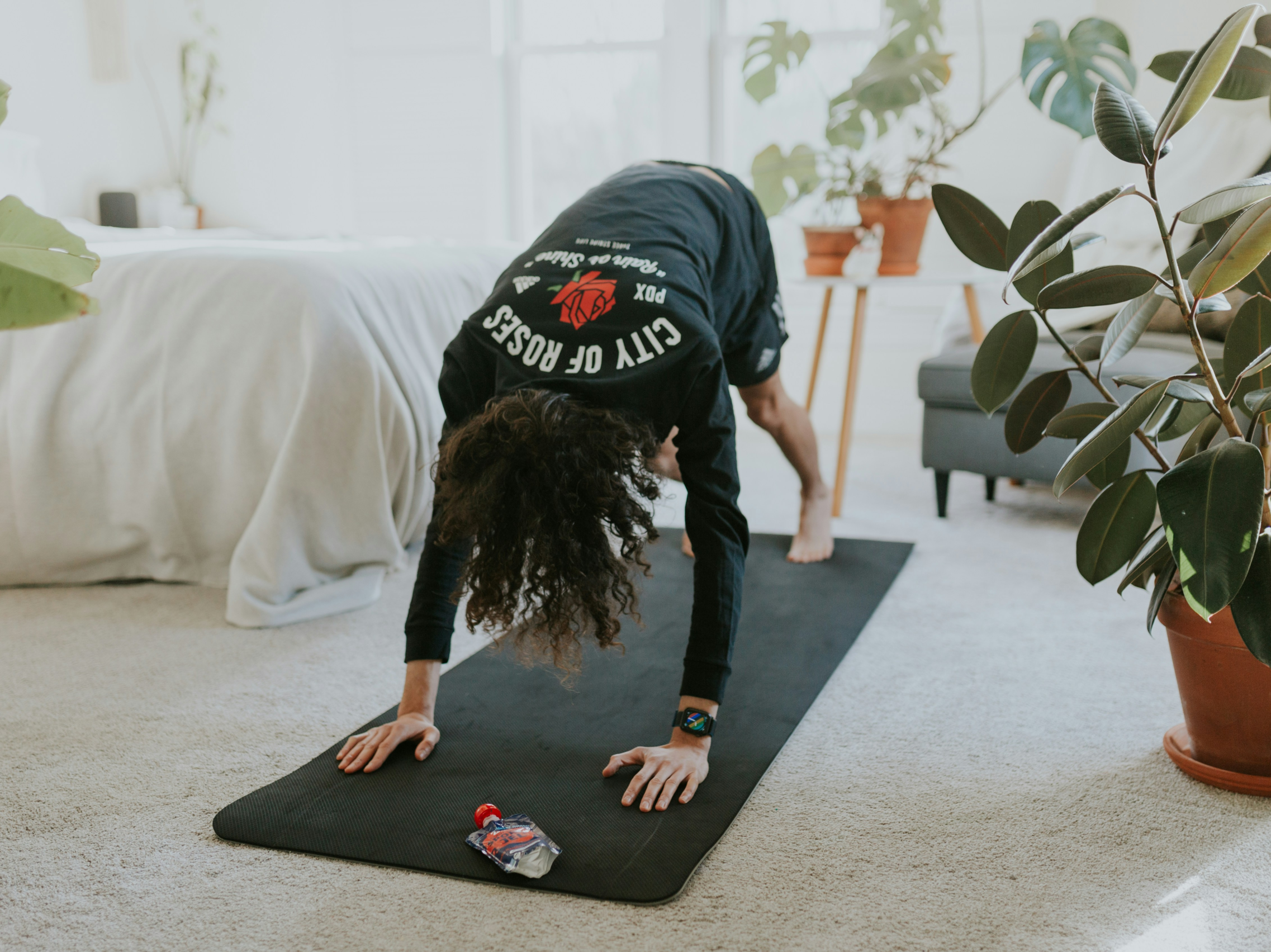
This post presents each of our homes as a great location to exercise. Home exercise does not require any complicated equipment or gym memberships, instead relying on an interest to learn how your body works. We can achieve fitness through home exercise, and we can easily expand, adapt, and personalize our home exercise with equipment that suits our interests and needs.
Throughout this post, I present resources that have helped me improve my home exercise setup and experience. These resources may be goods linked through affiliate links. If you purchase a good through these links, I may receive a small commission at no added cost to you.
In a Gym Jam
A major perceived barrier to entry into the world of fitness is not having a gym membership.
People always tell me “well, I’d love to work out, but I don’t have a good gym” or “I used to exercise all the time but I stopped going to the gym and now I’m out of it.”
The gym is a useful tool in our fitness arsenal because it provides access to a wide array of tools and space to use them, letting people tinker freely without the hassle of buying equipment or damage-proofing space. However, not everyone enjoys the gym, and its equipment is not necessary to become fit.
We Have Fitness at Home
I believe that everyone can achieve a high level of fitness through home exercise.
In fact, I believe that home exercise is a fantastic way to get stronger and more mobile. If we want to add a few pieces of equipment (like a pull-up bar, power tower, adjustable dumbbells, or adjustable kettlebell), we can spice up any home exercise and provide ourselves tons of fun and different ways to train.
If big gym lifting is our sport or hobby, home exercise with adjustable weights might not scratch that itch. However, exercise at home is a great option for those who enjoy fitness on their own terms, and I find working out at home to be my most enjoyable exercise experience.
Home as a Gym vs. Home Gym
Theres a huge difference between having a home gym and using what’s normally in your home to exercise.
First off, a home gym typically tries to replace a traditional gym by placing similar tools and features in your house. Home gyms tend to mean heavy equipment, power racks, and an atmosphere that says “I like to pick things up and put them down.”
On the other hand, using your home as it currently exists for exercise recognizes that we often have ample space and opportunity to do a good workout with the resources we have, and we might supplement those resources with some exercise equipment (like Bowflex dumbbells).
Using your home as a gym forces you to recognize that a bare wall is a great way to progress into push ups and, eventually, move into more advanced pressing ranges (like the handstand push up). Your home gives you plenty of places to step up, press, pull, and lean your way into better fitness.
Will it be as simple as going to a gym and ripping a circuit? Not necessarily. However, it gives you the space and privacy to take time and think about how you want to move and understand what is driving each exercise.
Benefits to Home as a Gym
Low Cost
Using your home as a gym costs no more money than it does to use your home for anything else. You already have access to the space given your living arrangement, and you are merely being active there.
With that said, you can save a lot of money using your home as a gym. Instead of paying a monthly fee to go somewhere and do push ups or push up alternatives, do them in your bedroom or living room! Do you live in a studio? Great, less time deciding which room will serve as your workout space.
Private
Once you figure out how to use your home as your gym, you will find yourself spoiled not only because of the low cost, but because you have complete control over privacy.
When we go to a traditional membership gym, we have to exercise around others. This can be motivating for some, and some benefit from watching others and learning new techniques. However, I find it far more common that exercising around others makes people anxious, resulting in a more negative experience and fear of branching out into more challenging workouts that the practitioner might be less confident about.
Our homes come with relative autonomy (depending upon our living arrangement) and the privilege of movement privacy. Do you have a new workout you’re interested in trying, but you don’t want to embarrass yourself if you mess up? Is it awkward to learn to activate your adductors (or pelvis more generally, which is key to developing leg control) in public? That issue tends to fade when you control the space.
Upgradeable
What is perhaps the best part of using our homes as a gym is that they are completely upgradeable depending upon our needs, resources, and interests.
The base home can accommodate training of most any body part. We can all find something heavy enough to move, and our bodies simply require new, stimulating movements to learn. At the same time, it’s pretty sweet when we can make our workout spaces into exactly what we want.
We can add weights that fit our desired type of training and features, subscribe to professionals who teach us new motions in the comfort of our own home, and even make our own home gym if that’s how we most enjoy to exercise. After all, it’s ours, so we are free to make it however we’d like.
Drawbacks to Home as a Gym
Our homes can accommodate most anything we need. However, they (typically) principally exist to serve a narrow purpose: provide us a place to eat, sleep, and store our belongings in a way that lets us interact with our communities as we desire.
While the conventional utilization of a home does not exclude its serving as an exercise environment, the general structuring of home may render it suboptimal for big workouts and expensive to upgrade.
There are three central drawbacks to a home serving as a gym, limited space, equipment, and an aversion to beating down our personal belongings with hard-wear exercises. Let’s discuss.
Less Space
Homes are expensive. Regardless of whether you live in an apartment, house, or your childhood bedroom, there are costs to home that are not easy to discredit.
The cost of our home depends on the location, space provided, and specific details of the home. Often, we have to sacrifice space to live where we want.
Commercial gyms benefit from the aggregation of interest in exercise to create an overall larger space. This is beneficial to the average exercise because, while we have to share the space with other people, not everyone exercises at the same time and we can generally have more space to ourselves to exercise by going to a gym when compared to home (especially if we avoid our gym’s peak hours).
Unless you can find a good deal on a home or are made of money, chances are you’ll have to compromise on space as it compares to a conventional gym.
Less Equipment
As previously mentioned, our homes are designed to serve as living spaces, not exercise zones. With that, we are unlikely to have the same quantity of equipment.
If you are used to exercising with all sorts of machines and free weights, it might be a big transition moving to exercising at home. However, if you take time to consider your objectives and utilize resources like Reddit’s r/bodyweightfitness, you will start to get in the groove and feel the home exercise benefits.
You may even come to realize that all the extra gym doodads were actually a distraction in your fitness journey. Not necessarily, but it’s a possibility.
Wear to Our Personal Belongings
Exercising is hard work. We are pressing, jumping, twisting, and throwing all sorts of mass around to achieve desired effects.
When we go to a gym, we exercise on equipment designed for fitness. We can sweat all over the place at the gym and, so long as we wipe down after our training, have no issues. The same cannot be said about our homes.
While our floors are meant to be moved around on, we can dirty our walls and furniture when we use them for our fitness pursuits. This comes down to your personal preference and what is most important to you.
If you have a couch that has already seen some wear, don’t want to spend money/ time going to a gym, and find you want to work on your elevated push-ups, you may be inclined to pop your feet on the edge of the couch and get to it. From there, you can work on your static foot press (like a big step-up, but not actually stepping up), your leg stretches, and any sort of mid-body bracing you might need.
Similarly, if you’re in an apartment or a room that already needs painting, you may find it more worth it to practice your handstand push ups there rather than going all the way to a gym and fighting for space. It’s all about what makes the most sense for your time and values.
Using Home as Gym- The Equipment
The Basics
Our homes already come loaded with some great basic equipment, and we can add more items as we deem fit. Let’s start with the basics:
Floorspace
With a little foresight and intention, we can exercise most (if not all) of our body with open floor space. Open space allows us to test our ranges of movement and how we can manipulate our bodies to accomplish a task. We can squat, push up, jump, roll, plank, and crab walk ourselves into great shape. Consider this article discussing working out in tight spaces for inspiration.1
I find that open floor space is among the best resources to build an understanding of fundamental lower-body mechanics. Realistically, we most often use our lower body to walk, run, and jump around.
Where are we doing that? The ground.
Learn to control how you interact with the ground. Teach your feet to land effectively, and use the spring nature of your feet, calves, joints, and musculature (as well as connective tissue, I wouldn’t dare forget reference to fascia in the modern fitness market).
Working with the floor will teach you to be more powerful where you are most likely to be. To gain access to progression work and learn to add angular aspects to your training, it is helpful to have a good wall available.
1If you aren’t familiar with Nerd Fitness, they are among the largest online fitness blogging and coaching platforms. They have tons of content falling into the ‘nerd’ mood, as well as compelling fitness guides written by professionals. Worth the look for inspiration and guides for the basics.
Walls
Open floor space is great fore training the up and down, the sprint, spreading out, and how we control our bodies generally. Once we start looking into these factors as they relate to a fixed point, we see the advantage of walls for our fitness training.
Walls provide supplemental support structures for our open study of movement. Instead of simply leaning forewarn to see how our legs engage to keep us upright, we can lean forward and press, now learning how our calves act in their attempt to drive us forward.
Walls let us play with gravity while having a frame of reference and a crutch. We can feel how we lean forward and develop our arm strength as they hold us up and keep us from crashing into the wall. We can flip over and work on our wrist, elbow and shoulder strength while in a braced handstand with our feet on the wall.
When we combine the ability to move from open space with the opportunity to add control and support through pressing against a wall, we open up a wide world for exercise. That world expands massively when we introduce entryways and door frames to our use of the home as a gym.
Walls with Doorframe
Walls with a doorframe are the power outlets of our home gyms (of course, unless you actually need electricity). Walls with doorframes open up our ability to connect different tools to our workout systems. These adorned entryways let up suspend pull up bars, straps, and a bunch of other workout tools. There isn’t much we can’t do for workouts if we have a good wall with a doorframe.
The best part is, the doorframe itself is an excellent exercise tool, discussed in its own right below.
Doorframe Itself
A doorframe opens our exercise to safe study of our end ranges of motion and unique positions.
Beyond serving as a connector for pull-up bars, a doorframe provides us with a sturdy structure to get ourselves into new positions.
For example, I use a doorframe to pull myself into a deep squat. Not only am I able to brace myself with the doorframe, but I can grab it and practice pushing away from the wall, giving me the opportunity to develop my leg pressing at wide ranges of motion.
I use doorframes to control and test how I can move in various positions. (ex. can my body rotate while squatted down? Can I shift my weight from one leg to the other? Can my knees move closer together? How about farther apart? How are my feet positioned? Can they move around, either by rotating or rolling the whole foot?).
I never considered the doorframe in my early working out at home, but it’s an invaluable tool for refining movement. Anything from isometric holds to strategic bracing and range of motion can be developed through use of the doorframe.
Chairs
Where a doorframe provides a stable place to brace ourselves and test ranges of motion, a chair serves as a mobile tool to develop movement across depth.
We typically use chairs to elevate us off the floor. That’s exactly how we will be using them in our exercises.
Want a more difficult push up? Try putting your feet on the chair and doing a decline push up. Need it harder than a wall push up, but not quite on the ground? Put your hands on the chair and press there!
Chairs can help us refine our sitting control, target our glutes, and adjust all sorts of movements by offering mobile elevation. When we want something a little more sturdy, we can look to the next options below.
Couch
A chair provides excellent options to add depth to our workouts and have a mobile platform. However, sometimes we don’t want our platforms to move around when we’re exercising.
If you want to add a stable layer of depth to your exercises consider using your couch! A couch gives you a place to practice step ups, balance building, elevation work, and unstable surface control (assuming your couch has cushions). It’s a staple of most households, and provides a pretty study place to change up how you interact with your body (I say pretty sturdy because, while some couches are set in their place, some are light or on slippery surfaces, causing them to move if we push them).
Bed
We often limit our beds to sleeping, but, when used properly, they serve as excellent exercise tools.
Like the couch, our beds provide excellent surfaces to diversify how we move around. We can do most all the same movement as we can on the couch, including step ups, and elevation-changed push ups. Additionally, we can work on our spread out body control.
Try this: when you’re on your bed, try reaching out as far as you can. Reach your arms out, your legs out, and feel how everything moves without being compressed while standing. You can then move into core rotations, back bridges, and other movements that require ample space and might need a little padding for your confidence.
Strong Additions to Our Home Workout Systems
If you read that all and thought to yourself, “Ok, great, but that’s not enough,” don’t worry, I’m here to help.
We have access to a wide array of workouts simply by having our own space, but that doesn’t mean we can’t add some tools to make it easier and/or more fun. The below recommendations are things that I personally own that have made working out at home easier and more fun.
Pull-Up Bar (Door Frame)
Pull ups are among the most important bodyweight exercises we can do. They are excellent for learning how our upper body works together and to develop the ability to position our bodies.
A door frame pull-up bar might be my most used piece of equipment of all time. These pull ups bars are light, sturdy, and offer a wide range of workouts.
The biggest piece of advice I can offer you for a door frame pull-up bar: if you care about your door frames, get a pull-up bar with additional frame pads or weight-distribution pieces. I have destroyed so many door frames with pull-up bars because I thought the foam on the bars themselves would be enough to protect the frames. It never is. Body weight needs to be distributed if we want to keep the doorframes looking good.
Indoor Dip Bars
As pull-up bars help us develop our upper body pulling control, dip bars help develop our pulling strength and control.
Our body is composed of layers of tools and systems designed to control movement. As some muscles pull things toward us, complimentary muscles exist to push them away. These muscles work in conjunction so that we can refine movement and protect against being knocked in either direction.
Pairing dip bars with pull-up bars will give you access to upper body movements across wide ranges of movement. These tools aren’t too expensive, last a long time, and can store easily.
If you want a more sturdy piece of equipment that combines both dip bars and pull-ups bars as one singular fixed feature, consider a power tower.
Power Tower (replaces above two)
You will be hard pressed to find a day where I’m home and haven’t used my outdoor power tower. If you have the space to install one and can live with the light eyesore, they are worth every penny.
An outdoor power tower gives you expansive opportunities to develop your movement. Not only can you do your pull ups and dips, but you can row, tricep press, and rotate your body into its next level of fitness.
I like having the power tower because it keeps my pull-up and dip bars permanently set up, reducing friction if I want to exercise. I like when I can get into and out of a workout as easily as possible so I have fewer barriers to fitness and can avoid negative associations from overdoing it. The power tower serves as my ideal solution.
Note: power towers often need to be secured so they don’t move around too much from hard pull ups or muscle ups. Sometimes, companies will try and hide that aspect. I think that’s deceptive, but I need the product and accept their trickery. Just be warned, as that can get dangerous if you aren’t careful.
Adjustable Weights (Bowflex)
Sometimes the most satisfying exercise is picking something up somehow. Adjustable weights are a great way to introduce resistance in a compact setting.
I am very fond of both my Bowflex 552 Dumbbells and my Bowflex Kettlebell. I have owned both of these for several years now, and am satisfied by their durability, weight increments, and compact nature. I also think they look pretty good (well, as good as a bunch of weights can look) and am impressed with their ability to be moved around (make sure you keep the strap that comes with the dumbbell base. That’ll save you tons of headaches if you move houses and want to take these bad boys mobile).
If you want wights that give you options and don’t eat up space, these are an excellent option.
Bands
While I’ve never been the biggest fan of bands (I’ve had one too many break on me), I recognize they are useful tools for a home gym.
Bands are very compact tools that allow us to add ranges of resistance and workout progressions.
Do you want to lightly test your shoulder rotation? A band can help.
Do you want to get a few more pull ups in, but you can’t manage a bodyweight one? Try band assisted.
As previously mentioned, I’ve been hurt one too many times by bands, so I will not recommend any to purchase. If you have good recommendations, send them my way! Who knows, maybe I’ll change my tune.
Yoga Mat (Cork is Best)
We can roll around our floors all we want. Nobody’s stopping us.
However, if we want a little padding (or just a clean surface to work with), yoga mats are helpful.
I try to pick yoga mats that add just enough padding to suit my needs. I find that too much padding reduces my stability, making it harder for me to improve my fine movement and hindering my overall workout.
In this pursuit, I have found cork mats to be best. Cork is naturally antifungal, keeping our workout surface feeling clean and nice. It has enough padding to suit my needs while also keeping me feeling stable.
Try a yoga mat if you haven’t! They make home workouts feel that much more legitimate.
Yoga Block (Cork is Best)
Yoga blocks are great additions to a home workout space. These blocks provide a light and convenient tool to challenge our stability, muscle control, and range of motion.
I find yoga blocks are helpful for testing the nuances of my movement. I can grab them with my feet or set them up in front of me and test my hip motion. Additionally, I can put one hand on the block and another on the ground to test how I work on uneven surfaces. They don’t seem like much, but yoga blocks provide a light but stable piece of variety that can help us develop our movement understanding.
As with the yoga mats, I prefer cork yoga blocks. They’re light, antifungal, and I just kind of like them. If you have other preferences, let me know!
Conclusion
While we are conditioned to think that the gym is where we need to go to pursue fitness, we can achieve our exercise needs (and dreams) in the comfort of our own homes.
We have tools at our disposal that we might not have considered for working out, but at the end of the day, working out should help us live our day-to-day better and it makes sense to use our day-to-day stuff to help us grow.
If we feel we want or need more equipment, our home exercise setup can always be upgraded. There’s no reason to avoid workout equipment if we want it or enjoy using it. However, it’s important we realize that equipment is not necessary to teach ourselves to move better.
Questions, comments or thoughts? Let me know!
-G
Did you enjoy this post? Consider checking out The Pitch to see what EfficientlyELITE is all about!
Leave a Reply