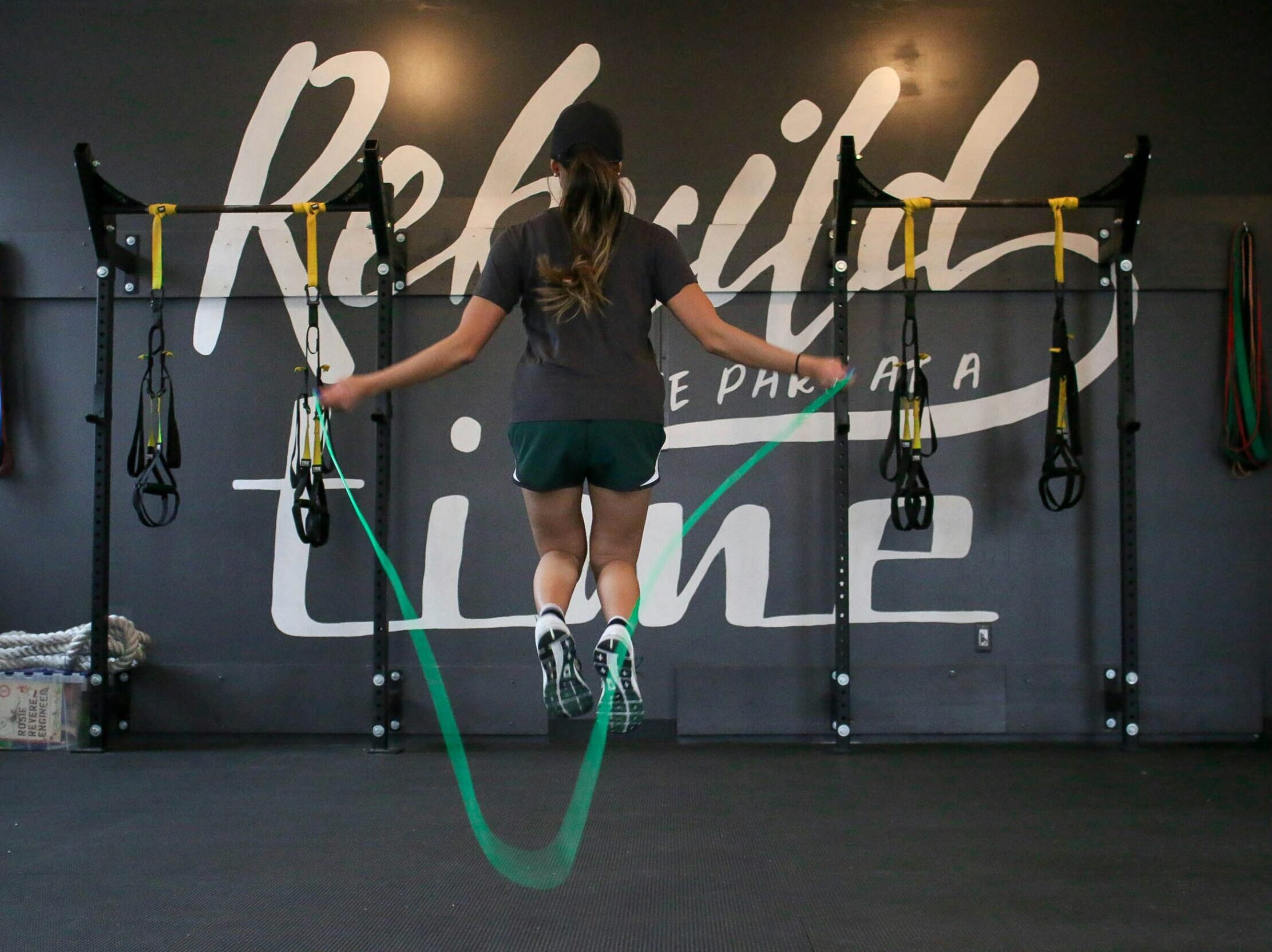
This post discusses the merits of jump rope and why you should add it to your workout routine. This post cautions against excessive training, particularly as it applies to jumping rope, because it can lead to injury and uncomfortable delays. Finally, this post presents an exemplar routine and recommends various products.
I have linked resources that have been helpful to me. Some of these resources are products (such as books) available for purchase. These products may be linked through affiliate links. If you click on a link and make a purchase, I may receive a small commission at no extra cost to you.
Let’s Jump to It
Jumping rope is a great full-body workout that gives you the opportunity to build explosiveness, springiness, and an overall healthy form.
The activity is simple (in concept): you acquire some sort of rope, and you jump over it. Sounds pretty easy, right? It’s rare to see a movie that involves a school and doesn’t show young children jumping rope.
Anyone who has tried using a jump rope for a workout knows it is anything but easy.
Jumping Rope is Hard Work
While we may think of jumping rope as a bunch of kids playing with colorful beaded ropes, it is both a great and demanding exercise.
Jumping rope involves a series of explosive movements in quick succession at varied tempos. Jumping rope asks the jumper to control the height of their jumps, foot positioning, and speed all while managing a piece of plastic swinging around their bodies.
Each hop tests our whole body tension. If we are not tense, our body collapses a bit in the area lacking tension, causing us to expend more energy to keep ourselves up and maintain our cadence.
Beyond requiring initial full-body tension, jumping rope continually challenges our positioning, and our form fades as we continue to do it. As we continue to hop, we feel different areas tire, potentially exposing them to injury while also providing us information on where we can improve.
Until you’ve tried jumping rope, you’d be amazed at just how fast it burns energy and compromises form. However, once you learn to do it right, you’ll see it as an irreplaceable tool to refining how your body works at speed.
Why You Should Be Jumping Rope
Jumping rope is an excellent way to improve footwork, explosiveness, speed, and endurance.
Its high intensity and frequency quickly point out the weak links in our body that impact our control and tension, and even a few minutes of jumping can provide an excellent workout.
Jumping rope is a useful workout to learn to understand your body (particularly your legs, but everything is involved) under intense movement. I find that jumping rope has dramatically improved my straight-leg mechanics, as well as my body positioning and control.
A Warning Before You Start Jumping Rope
I know you may have jumped rope in the past, but it cannot be emphasized enough how demanding jumping rope can be on your lower legs. Each impact drives all your weight into your calves, and you will be quick to learn just how much training your legs need to be able to consistently move your body around.
When you start jumping rope, take it light! Even if your heart and lungs can handle it, you are driving a lot of work through your legs. If you push it too hard when you start, you are more likely to injure yourself, and that negative experience will make it infinitely harder to get back into it.
My Jump Rope Routine
I like to build a lot of flexibility into my jump rope routine once I get going, but I generally start the same way. No matter how many fancy jumps, double-unders, and twists we mix in, there are common foot landings we experience when we jump, and I like to get my feet ready to start. At the beginning of every jump rope workout (and sometimes, as the whole workout) I do this:
Base Warm-Up
- Both feet regular hops (20x)
- These are the typical jumps you would do if you picked up any jump rope and got to it. Your goal is not to throw yourself through the air like Jordan, but instead to get yourself off the ground enough to slip the rope under you for your next step. I find 20 is enough to get me warmed up and going.
- Single foot alternating hops (20x)
- When we walk and run, we put one foot down and then the other. That’s what we’re doing here. Focus on getting your feet firing at a comfortable tempo and alternating each hop. Whether you’re walking or dodging an oncoming defender, you need to learn to control your feet one at a time.
- Single foot hops (10x each time)
- Single foot hops help me refine how each foot is moving. This is where I learn just how strong each leg is, and where I need to adjust. NOTE: as you get tired, this is where you start to bang up your shins, so take it easy and work toward it!
- Slow and High (10x)
- Focus on giving yourself a little extra pop off the ground each time, paying attention to how your tempo and balance change.
- Regular, both legs (10x)
- Speed (10x)
- Only go as far off the ground as you need to. This one is asking for you to push your speed to the limit.
More Advanced Additions
- Cross Overs, Double Leg (Cross one direction, regular both feet hop, cross other direction) (10x)
- The double leg cross overs help me refine my tempo and positioning. I like to go from one side, to both feet, to the other side to add some rhythmic complexity to my jumping and keep me thinking about how I land
- Cross Overs, Single-Foot Alternating Hops (10x)
- Same crossing pattern as before, but alternating feet each time. This really starts to challenge your focus and foot control
- Double-Unders (10x)
- Double-unders test your explosiveness, rope speed, and endurance. Once you get the hang of it, you shouldn’t have to jump any higher than you do with your regular hops (if you have a heavy enough rope and some bearings, 1/4 lb works well). These are demanding on your shins, so build slowly!
- Alternating Foot Slow and High (10x each foot)
- This one moves into the advanced section not because of the complexity of the movement, but because of the calf demand and potential for injury. Each blast off upward gives you a harder landing on the other leg. Your goal is to build up your power and timing.
- Core Twist, Alternating (10x)
- We don’t always land with our feet forward, and neither should we in jumping rope. Try keeping your chest pointed forward and landing with your core rotated to the side so your legs land approaching a 90 degree twist. Alternate between one direction, normal land, and other direction.
- Core Twist, Same Side (10x)
- Instead of changing directions each time, keep yourself twisted in one direction and try and control a consistent hop.
- Lateral Hops
- While facing forward, keep jumping while taking a few hops leftward. Try and keep your balance and keep hopping. Hop back toward your starting point and repeat.
- Forward and Backward (both single and double foot)
- Mixing movement into our jumping further tests our timing and coordination. Try hopping with both legs and single leg backward and forward while keeping the rope moving to get the ultimate leg test.
Post Warm-Up Freestyle
Regardless of whether I stick to the basic warm-up or add in the additions, I always like to mix in time for freestyle hopping. In my freestyle time, I focus on keeping my feet actively moving and transitioning from one type of hop to the next. I’ll go from double legs, to cross-overs, to big hops, etc. until I find myself tangled or tired. The freestyle sessions are most important to me because they keep me moving at my sharpest while mixing fun into the workout.
Note: freestyle times are also where you’re most likely to tire and get tripped up. It’s fun when you get the rope moving nicely and feel good, but remember there is always more jump roping to do and try and preserve your body so it isn’t in pain for the next session.
Jump Rope Recommendations
The quality of jump rope you purchase depends on the surface you foresee jumping on and how frequently you plan to do it.
You can get jump rope sets for over $100 (like my favorite, which I’ll discuss more below), but this is probably overkill unless you’re regularly jumping on asphalt (which I do).
For me, the most important factors in a good jump rope are the cord material, presence of handle bearings, and the option to replace the cord (for when it eventually wears.
I like my jump rope to have a relatively thick cord made of solid plastic (or plastic-wrapped metal wire). The thickness helps me see it as it’s moving around, and I prefer plastic wrapped as it stinks less when you’re inevitably hit by the rope (even the best get hit sometimes). I find that the plastic-beaded ropes hurt much more when they hit me at speed, and the cords wear too quickly when only thinly wrapped in plastic (some of the less expensive brands will have metal wire with a thin plastic sheath. This can wear out after one session on asphalt, causing the metal wire to fray and hurt A LOT). These ropes tend to be in the 1/4 pound category.
Beyond the solid plastic cord, handles with bearings dramatically improve the jump roping experience. If you’ve jumped rope before with a non-bearing handle, you know how easily the rope can get twisted and tangled up in itself. This limits how long you can jump and, in my opinion, ruins the experience. Even inexpensive bearings change the game.
Finally, I find replaceable cords to be important to a good jump rope. Unless you’re strictly jumping rope inside (in which case, you can opt for something more inexpensive like this), your jump rope cord will wear out over time. Maybe you can only jump rope on your driveway or public basketball court, or maybe you split time between indoor and outdoor jumping. If you have decent handles you like, it’s nice to be able to plug new cord in and make things new. After all, isn’t it better to consume less when we can?
My overall favorite jump rope has been the Cross Rope Get Lean set. While expensive, I find this set is of the highest quality, can handle all of my workouts, and comes with both 1/4 and 1/2 pound cord options if you want to mix in a little shoulder strength work.
Additional Recommendation: Jump Rope Mat
We don’t always have an open indoor space with nice floors to jump rope. Sometimes, we have to settle with outside spaces and hard surfaces for jumping. If we want to save our rope (and our shins), it is helpful to have a good jump rope mat. A good mat, which looks something like this, or this, or this, provides a stable jumping surface while giving us much-needed cushion. Additionally, it gives us a better sense of where we are jumping and improves our awareness of the area around us. I personally use something like this one, as I like the round zone and find the cushioning comfortable (but not so much that I lose my sense of footing). Try one out!
Conclusion
Jumping rope is a great addition to any workout routine, but it must be approached with caution. If you plan your workouts to build gradually, you can dramatically improve your coordination and footwork. Take it light, and you’ll see nice improvements in no time!
Questions or suggestions? Let me know!
-G
If this post interests you and you’d like to learn more, consider reading The Pitch to see what Efficiently ELITE is all about!